Start here
Tea with a maiko: worth it?
What the ninety-minute maiko tea ceremony near Gojō includes, what it leaves out, who it suits, and why the eight-day cancellation rule matters.
Choose a date for the tea ceremony ↗Quick answer
Yes, for most visitors on a first trip who hope to meet a maiko or geiko face to face without the introductions an ochaya party requires. In about ninety minutes you whisk your own matcha with two dry sweets, ask her about her life, take a photo, receive a senjafuda slip and watch two dances. Know the limits before you pay: the room is plain and may be shared with diners, the host speaks Japanese, there are stairs and no lift, and cancelling is free only until eight days before.
In the ticket, or not
| Included? | |
|---|---|
| Tea ceremony with a maiko or geiko | Yes |
| Matcha you whisk and two dry sweets | Yes |
| Q&A, photo and senjafuda gift | Yes |
| Two dances and a party game | Yes |
| A meal | No |
| Front-row seats | Optional, paid at the venue |
| Guaranteed English translation | Optional, extra fee |
The short answer
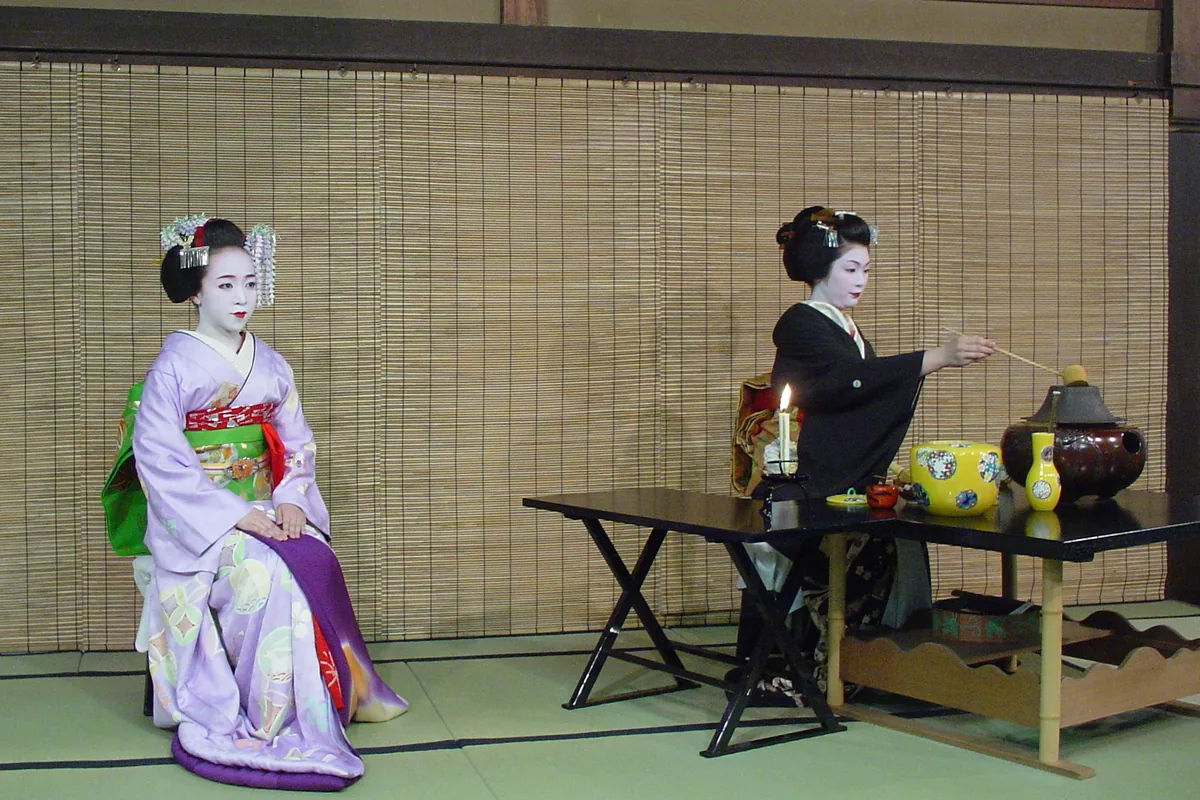
It earns its place if your picture of meeting Kyoto's geisha world is a seat a few metres from a maiko, a bowl of tea you made yourself and the chance to ask her what her days are like. That is exactly what the programme sells, and it fits inside an afternoon or an early evening. Think twice if you picture lanterns, tatami and a wooden teahouse in Gion, because the setting is an ordinary room in a building near Gojō Station. Think twice too if your dates could still move: the free-cancellation window closes eight days before your session, much earlier than the 24-hour window on the Gion walks this site also covers.
What the ninety minutes include
The programme lasts about ninety minutes from the start time on your booking. Each item on this list comes with the ticket. The host leaves before the very end, and the final stretch is set aside for chatting with the people around you and collecting your things, so do not count on her being in the room for the full ninety minutes.
- A tea ceremony in which she demonstrates matcha and you whisk your own bowl
- Two dry Japanese sweets with the tea
- A question-and-answer session about her daily life
- A commemorative photo beside her and a senjafuda slip as a gift
- Two traditional dances and a simple party game with guests
Maiko or geiko: why nobody can tell you in advance
The provider brings in either a maiko or a geiko, chosen for each day, and cannot confirm which in advance; the content of the programme is the same either way. The difference is mostly in how she looks. A maiko is an apprentice, usually recognisable by her long-sleeved trailing kimono, her very long darari obi, the red collar at her neck and an elaborate hairstyle made from her own hair. A geiko, the Kyoto word for a fully qualified geisha, wears shorter sleeves, a white collar and often a wig. Either way, you are meeting a working member of one of Kyoto's geisha districts.
Read next: Maiko and geiko: who is who
Who it suits best
The programme works well for couples, groups of friends and families with school-age children, all curious about the geisha world and want a conversation, not a performance seen from a distance. It suits a first visit to Kyoto, when you have neither the introductions an ochaya requires nor the time to wait for a district's spring dances. It also suits travellers who would rather sit than walk after a day of temples. Photographers get a guaranteed portrait opportunity, which no street in Gion can promise.
The room, and why it isn't a teahouse
Parties with geisha traditionally happen in an ochaya, a licensed house in a geisha district where patrons are entertained. Entry to an ochaya is normally limited to established patrons and the people they bring, which puts it out of reach for most visitors. This programme takes another route: it is held in a room in a building rather than an ochaya or a traditional house, and the session may run while other people in the space are having lunch or dinner. Go in expecting a plain setting and the host will carry the afternoon.
The tea you make
The tea ceremony, chanoyu in Japanese, centres on preparing and serving matcha, powdered green tea. What you make here is closer to thin tea, usucha, in which powder and hot water are whipped with a bamboo whisk called a chasen until the surface turns frothy. Thick tea, koicha, is a more formal and far stronger preparation that you will not be asked to make. Your two sweets are dry confections, the kind a host traditionally brings out to go with thin tea. In a formal gathering the sweet comes before the tea.
Read next: Matcha, sweets and the bowl
Language and the translation guarantee
The host speaks Japanese. English translation is provided as far as possible. If clear English matters, for example because a child in your group will want to follow the Q&A, the provider offers an English translation guarantee for an extra fee. You arrange it by contacting the provider after you reserve, not at the door, so do it as soon as your booking is confirmed. Writing your questions down in advance helps whichever way you go, because every answer has to travel through translation.
The eight-day rule
This is the term most likely to catch you out. Cancellation through GetYourGuide is free until eight days before your session, not the 24 hours many other Kyoto activities allow. Inside eight days there is no refund. Changing the date or the time is also treated as a cancellation, so you cannot slide the booking to a different afternoon once the window has closed. The practical rule is simple: book this as soon as the day it falls on is certain, and not before.
Stairs, seats and children
There is no lift in the building, and every room is reached by stairs. Seats in the first, second and third rows are sold as optional upgrades at the venue, as is a snack; everyone else watches the same programme from further back. Children under two who sit on a parent's lap go free. Only people booked on the programme may enter the room, so a partner who would rather skip it cannot wait inside.
Five checks before you book
Tick off each line before paying. Most disappointment with this kind of programme comes from expecting a teahouse, a meal or a promise about who will host, none of which the ticket offers. If every line below suits your group, the ninety minutes are likely to be the most personal hour you spend with Kyoto's geisha tradition on a short visit.
- Your date is fixed at least eight days ahead
- Everyone can climb stairs, since there is no lift
- You are happy with a maiko or a geiko, whoever comes
- A plain room, possibly shared with diners, is fine
- You will follow Japanese with English translation, or will book the guarantee
Who this isn't for
Pass on it if you want a full banquet with geisha, since no meal is served and the tea and two sweets are the only food in the price. Skip it if a traditional setting matters more to you than the person hosting, or if anyone in your group cannot manage stairs. Travellers whose plans may change inside the final week should look at activities with a 24-hour window instead. And if your real wish is simply to see Gion's lanes and perhaps glimpse a maiko on her way to work, a guided walk will suit you better and cost less.
Read next: Maiko tea or a Gion walk?
Frequently asked questions
How long does the maiko tea ceremony last?
About ninety minutes from the start time on your booking. The maiko or geiko leaves before the very end, and the last part is time to chat and gather your things.
Can I choose between a maiko and a geiko?
No. The provider sends one or the other according to the day and cannot say in advance who will come. The programme is the same with either.
What if I need to cancel?
Cancelling is free up to eight days before your session when you book through GetYourGuide. After that there is no refund, and moving the date or time counts as a cancellation.
Do I need to know anything about tea?
No. She demonstrates how matcha is made before you whisk your own, and there is no test. Thin tea, the kind you make, is the more relaxed form of the ceremony.
Is it held in Gion?
No. The venue is a room in a building a short walk from Exit 1 of Gojō Station on the Karasuma subway line, not in a geisha district.
Can I take photos?
Yes. A commemorative photo beside the maiko or geiko is part of the programme, and she gives each guest a senjafuda slip as a gift.
Sources